Wednesday, August 20, 2008

CSA update and Planet Green

Here's a picture of yesterday's share from the CSA that a few of us belong to (here's a link to an entry about our first visit).  Included goodies are:  summer squash, carrots, lettuce, celery, swiss chard, corn, cucumbers, green beans, peaches, asian pears, sweet and hot peppers, new potatoes, baby beets, onions, tomatoes, basil and edamame.  Most weeks there are pick-your-own opportunities as well (including flowers), and there are cut herbs available.  Having had my own veggie patch in the past, I've always appreciated that fresh produce has so much more flavor than store-bought, so that was no surprise.  I am amazed at the variety of vegetables that have been available and my friends and I have had more than a few how-do-you-prepare-this phone calls when a new-to-us veggie has appeared in the week's harvest.  I do find myself planning my meals around what's available and that has helped me to expand my culinary skills (which my husband really appreciates!)

After supper last night (which included one of those wonderful tomatoes!), I took a break from my marathon Olympics viewing to catch up on a couple of episodes of my favorite shows that I DVRd from Planet Green.  The first show I'd like to recommend is Focus Earth with Bob Woodruff (produced by ABC news) which is a weekly news show that digs deeper into environmental topics.  The other show I'm really enjoying is Supper Club where a "green" chef cooks for celebrities and authors who discuss environmental issues (both pros and cons) over their meal.  Here are two interesting but random items from the show I viewed last night:  
  • Author Tom Kostigan offered a tip he'd just learned.  If you are at the grocery fish counter and you can't remember which fish is a healthier and/or sustainable choice, you can text "30644 fish X", with the X being the name of the fish you are wondering about, and you'll get a text right back with the pertinent information.
  • Author Sophie Uliano (Gorgeously Green) while debating whether the individual can truly make a difference or only governments can solve global warming stated, "You vote with your dollar."  This just struck me to be very true.

Wednesday, August 6, 2008

Give your clothes a vacation

....from the dryer!  Summer is the perfect time to reduce your carbon footprint by using solar power to dry your clothes.  According to the State of California, the use of a clothesline can save 1,000 mw/day of electricity and they are encouraging residents to use clotheslines to help prevent brownouts there.  They estimated that by hanging out just 1/4 of your laundry, you'll save $30 per year.  The EPW Blog states, " There were more than 88 million dryers in the US in 2005. 'If all Americans line-dried for just half a year, it would save 3.3% of the country’s total residential output of carbon dioxide, experts say.' 3.3%! That’s huge if you think about how much CO2 all the households in the US emit. As for the impact on the wallet, the average clothes dryer costs about $160/yr to run. "

Other benefits of hanging out:  clothes smell great, less shrinkage, the sun kills germs, and clothes last longer (all that lint is worn-away fabric).  I like it because I'm more aware of the outdoors--I have to be aware of the pollen count and plan for rain, although I do have lines strung in my basement for winter use.

I use an umbrella style clothesline which doesn't sag the way a line stretched from tree to tree does.   Generally, I hang clothes upside down to prevent clothespin marks on my shoulders and things I don't want to fade get turned inside-out.  I fold right off the line to smooth out any wrinkles but dressier clothes might need 2 to 3 minutes in the dryer on the "wrinkle release" setting.  More tips can be found on the GardenWeb which has forums on all sorts of interesting topics! 

Tuesday, July 29, 2008

Eco-friendly wallpaper removal

Okay, I know this is not on the top of everyone's to-do list but you might be able to guide your painter toward this natural solution to removing wallpaper.  My kitchen reno is now complete and as I emptied out the room we were using as our temporary kitchen, I decided it was the perfect time to remove the previous owner's 80's wallpaper.  Never being patient enough to get on somebody's schedule, I decided to tackle this myself.  Most of the paper was vinyl and peeled right off but there was a wall that had a different paper beneath which required the use of a steamer to remove.  No scoring the wall, no spraying with DIF, just hold the steam plate in place for about 30 seconds, lightly scrape, and move to the next section.  That wall took about 45 minutes.  Next I had to tackle the residual glue stuck to all the walls.  I had read that vinegar and water was all that's needed and, indeed, with a light action with a metal scrubbie, a rinse with a wet sponge and a final swipe with a dryish towel and I'm ready to spackle!  I have to say that this method is far easier than any other method I've used.  I just wish I'd stop thinking about pickles!!!

Monday, July 7, 2008

Rain Gardens

Often, when we think about environmental issues, our focus is on our carbon footprint, the oil crisis or toxic products we are using in our homes. However, if you think back to last summer's water crisis in Georgia, you'll realize that water conservation is equally important.  
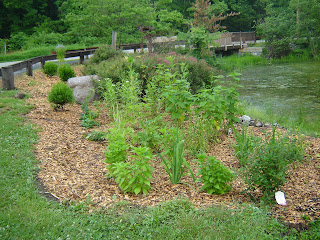
     Rain gardens can be an effective way to divert clean rainwater back into the ground water system instead of being wash over driveways, streets and sewers collecting contaminants from pets, lawn chemicals and road pollutants. Lynn sent me the following note and pictures. "I thought you might like to see the rain garden the Rockaway Valley Garden Club built last week.  The water runs off the road into this area and all the plants are natives . It is located next to the grammar school on Valley Road in Boonton Twp. (take Powerville Road to Valley Road)."

Tuesday, June 17, 2008

Green Dumpsters Anyone?


We are nearing the end of our kitchen renovation and trying to be as environmentally friendly as possible.  I was able to sell much of my old kitchen components on Craig's List, but we were amazed that our contractor still managed to fill an entire dumpster with debris despite my hovering and pulling out what recyclables I could.  Mary stopped by for a visit and told me about green dumpsters.  What is a green dumpster, you say? Well, a traditional dumpster goes directly to the landfill, while about 75-85% of the contents of the green dumpster gets recycled. The green dumpsters also cost less.
Two weeks ago, she visited Cardella Waste, in North Bergen, a facility that recycles building waste. The trucks dump their loads, and the waste is separated into metals, plastic, concrete, wood, glass and sheetrock. They service large and small projects and have over 60 years experience in waste removal. They can contribute to LEED certification as well.
So, spread the word to your friends and mention the League of Women Voters if you contact Cardella’s. With the benefits of recycling and lower cost, who wouldn’t want a “green” dumpster?

Monday, June 9, 2008

More on Battling Bugs


Last week's entry on emergency bug sprays was a response to my own bug crisis.  Although I mentioned that overcrowding was stressing my usually garden-hardy Black-Eyed Susans, what we really need to talk about is that the best way to control pests is to maintain an organic garden with plenty of native plants.  By using organic methods such as composting, using natural fertilizers and minerals, protecting beneficial insects by eliminating the use of broadly-applied pesticides, reducing pavement, corralling rain run-off, changing cultural attitudes toward lawns or just planting better adapted varieties of garden plants CAN break the cycle of chemical dependence that we've all become accustomed to. I was surprised to learn that bare soil in full sunlight is 25-35 degrees warmer than nearby soil under mulch or plant cover.  Can large expanses of manicured lawn be that much cooler?
     Bonnie sent me a link to this National Geographic Green Guide which suggests that "plant-based pest control comes from the beneficial bugs and insect-eating animals the plants attract. These pest-eaters include some birds (bluebirds, chickadees and hummingbirds are a few), bats, lizards, ladybugs, praying mantises, dragonflies, spiders, green lacewings, hoverflies, parasitic wasps and predatory mites. They will flock to a healthy, balanced ecosystem to fight the bug battle for you. Choose a varied mix of plants, with edibles alongside flowering plants like clovers, marigolds, and members of the mustard, sunflower, celery and carrot family, whose nectar helps feed beneficial bugs and birds. Keep these plants healthy year-round if you can, so beneficial insects have supplementary food and dependable shelter as they control bugs throughout the year."  The NJ Audubon Society lists a dozen "must-haves" for a backyard habitat and Organic Gardening has suggestions for a wildlife garden (however, we should definitely skip the "treat" section with our local bear problem!)


Thursday, June 5, 2008

BUGS!!


     Things had been going so well in the garden.  I've been focusing my attention on the big picture--thinking about the hardscaping and landscaping that would give me the bones I need to start moving the overgrown clumps of perennials left by the previous owner.  All that overcrowding really stresses the plants and, this week, I've had some major infestations of aphids and (I think) flea beetles.  Naturally, I'm looking for organic pest control methods to wage war on these nasties.  The aphids are easy to get rid of with a strong blast of water.  My preferred method, however, is soaking the area with a spray of soapy water.  I always mix it on the fly so I don't have exact measurements.  You can see the dead aphids on the picture above--no live green aphids were to be found two days later.
     The flea beetles are trickier to get rid of since they love the crowded conditions and undisturbed soil.  If you look closely, you can see the telltale tiny holes they leave.  The good news is that they are most harmful on tender young transplants and my established clumps of Black-eyed Susans should survive.  Organic Gardening gives a very thorough explanation of their lifecycle and ways to limit their damage.  I've also found a few blister beetles which are black and yellow, much like the cucumber beetle and they make bigger holes.  This month's Organic Gardening Magazine gives a recipe for an all-purpose spray which, they say, works on a multitude of pests, including slugs and Japanese beetles:  
Chop 1 garlic bulb and 1 small onion in a blender.  Add 1 teaspoon powdered cayenne pepper and 1 quart water.  Steep for 1 hour, then strain through cheesecloth.  Add 1 Tablespoon liquid dish soap so the spray sticks to the plant leaves.  Mix well.  Spray the mixture on both sides of the leaves.  Store remaining spray in a labeled jar in the fridge. Note:  certain plants are very sensitive to soaps and can develop leaf burn.  Always test on a leaf or two the day before spraying the whole plant.